Right-Sizing Confidence: Object Detector Lowers Confidence for Unfamiliar Inputs
ResNet

Right-Sizing Confidence: Object Detector Lowers Confidence for Unfamiliar Inputs

An object detector trained exclusively on urban images might mistake a moose for a pedestrian and express high confidence in its poor judgment. New work enables object detectors, and potentially other neural networks, to lower their confidence when they encounter unfamiliar inputs.


June 1, 20222 min read
Less Data for Vision Transformers: Boosting Vision Transformer Performance with Less Data
ResNet

Less Data for Vision Transformers: Boosting Vision Transformer Performance with Less Data

Vision Transformer (ViT) outperformed convolutional neural networks in image classification, but it required more training data. New work enabled ViT and its variants to outperform other architectures with less training data.

May 4, 20222 min read
Less Data for Vision Transformers: Boosting Vision Transformer Performance with Less Data
ResNet

Less Data for Vision Transformers: Boosting Vision Transformer Performance with Less Data

Vision Transformer (ViT) outperformed convolutional neural networks in image classification, but it required more training data. New work enabled ViT and its variants to outperform other architectures with less training data.

May 4, 20222 min read
The Limits of Pretraining: More pretraining doesn't guarantee a better fine-tuned AI.
ResNet

The Limits of Pretraining: More pretraining doesn't guarantee a better fine-tuned AI.

The higher the accuracy of a pretrained model, the better its performance after fine-tuning, right? Not necessarily. Researchers conducted a meta-analysis of image-recognition experiments and performed some of their own.

February 9, 20222 min read
The Limits of Pretraining: More pretraining doesn't guarantee a better fine-tuned AI.
ResNet

The Limits of Pretraining: More pretraining doesn't guarantee a better fine-tuned AI.

The higher the accuracy of a pretrained model, the better its performance after fine-tuning, right? Not necessarily. Researchers conducted a meta-analysis of image-recognition experiments and performed some of their own.

February 9, 20222 min read
Transformers See in 3D: Using transformers to visualize depth in 2D images.
ResNet

Transformers See in 3D: Using transformers to visualize depth in 2D images.

Visual robots typically perceive the three-dimensional world through sequences of two-dimensional images, but they don’t always know what they’re looking at. For instance, Tesla’s self-driving system has been known to mistake a full moon for a traffic light.

January 26, 20223 min read
Transformers See in 3D: Using transformers to visualize depth in 2D images.
ResNet

Transformers See in 3D: Using transformers to visualize depth in 2D images.

Visual robots typically perceive the three-dimensional world through sequences of two-dimensional images, but they don’t always know what they’re looking at. For instance, Tesla’s self-driving system has been known to mistake a full moon for a traffic light.

January 26, 20223 min read
Richer Video Representations: Pretraining Method Improves AI's Ability to Understand Video
ResNet

Richer Video Representations: Pretraining Method Improves AI's Ability to Understand Video

To understand a movie scene, viewers often must remember or infer previous events and extrapolate potential consequences. New work improved a model’s ability to do the same.

November 3, 20212 min read
Richer Video Representations: Pretraining Method Improves AI's Ability to Understand Video
ResNet

Richer Video Representations: Pretraining Method Improves AI's Ability to Understand Video

To understand a movie scene, viewers often must remember or infer previous events and extrapolate potential consequences. New work improved a model’s ability to do the same.

November 3, 20212 min read
Oddball Recognition: New Method Identifies Outliers in AI Training Data
ResNet

Oddball Recognition: New Method Identifies Outliers in AI Training Data

Models trained using supervised learning struggle to classify inputs that differ substantially from most of their training data. A new method helps them recognize such outliers.

October 6, 20212 min read
Oddball Recognition: New Method Identifies Outliers in AI Training Data
ResNet

Oddball Recognition: New Method Identifies Outliers in AI Training Data

Models trained using supervised learning struggle to classify inputs that differ substantially from most of their training data. A new method helps them recognize such outliers.

October 6, 20212 min read
More Thinking Solves Harder Problems: AI Can Learn From Simple Tasks to Solve Hard Problems
ResNet

More Thinking Solves Harder Problems: AI Can Learn From Simple Tasks to Solve Hard Problems

In machine learning, an easy task and a more difficult version of the same task — say, a maze that covers a smaller or larger area — often are learned separately.

September 29, 20212 min read
More Thinking Solves Harder Problems: AI Can Learn From Simple Tasks to Solve Hard Problems
ResNet

More Thinking Solves Harder Problems: AI Can Learn From Simple Tasks to Solve Hard Problems

In machine learning, an easy task and a more difficult version of the same task — say, a maze that covers a smaller or larger area — often are learned separately.

September 29, 20212 min read
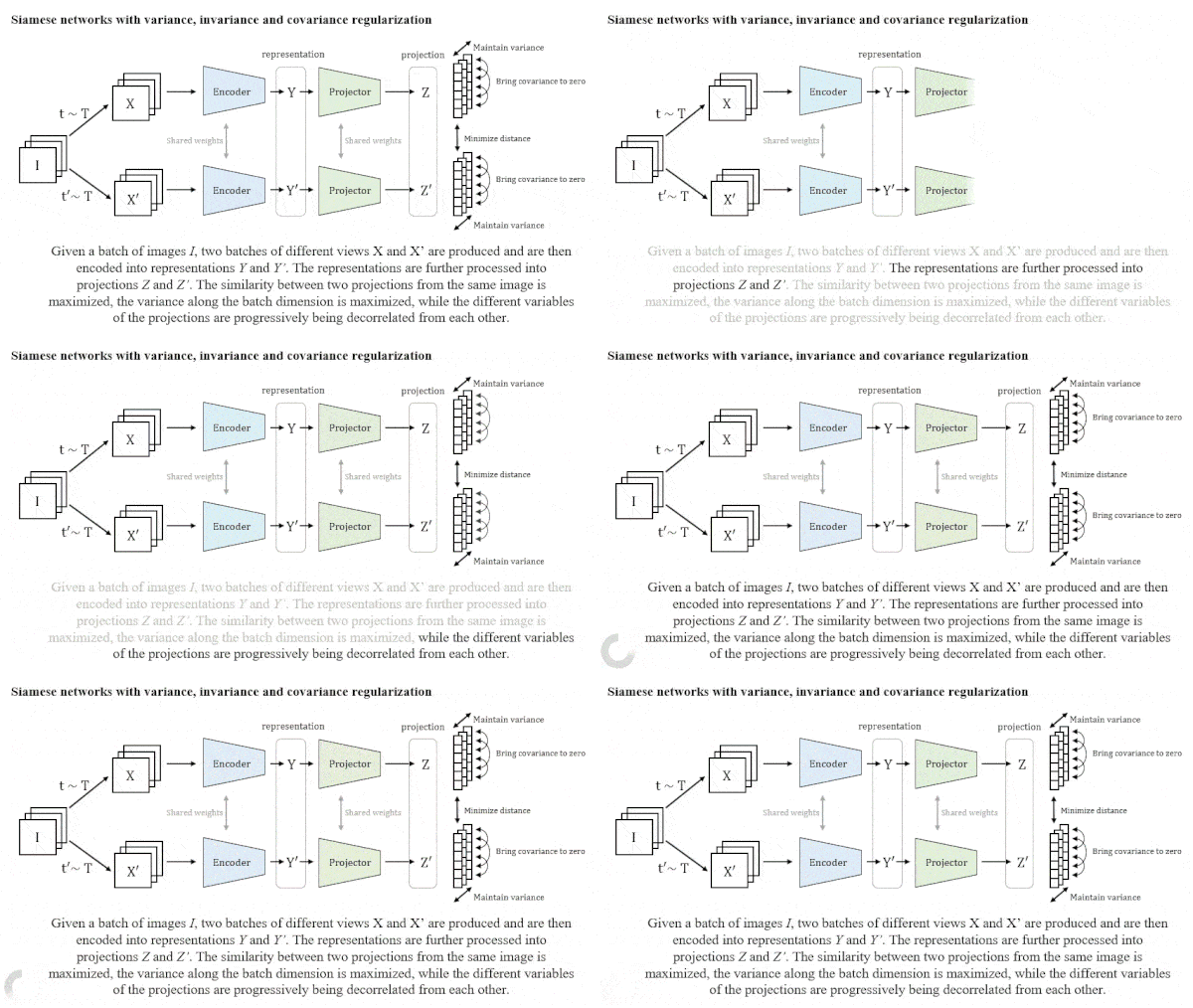
More Reliable Pretraining: Pretraining Method Helps AI Learn Useful Representations
ResNet

More Reliable Pretraining: Pretraining Method Helps AI Learn Useful Representations

Pretraining methods generate basic representations for later fine-tuning, but they’re prone to certain issues that can throw them off-kilter. New work proposes a solution.

August 25, 20212 min read
More Reliable Pretraining: Pretraining Method Helps AI Learn Useful Representations
ResNet

More Reliable Pretraining: Pretraining Method Helps AI Learn Useful Representations

Pretraining methods generate basic representations for later fine-tuning, but they’re prone to certain issues that can throw them off-kilter. New work proposes a solution.

August 25, 20212 min read

Subscribe to The Batch

Stay updated with weekly AI News and Insights delivered to your inbox