
Build a data agent using a multi-agent workflow: design a planner, a plan executor, and specialized sub-agents to connect to data sources.

Intermediate
Building and Evaluating Data Agents
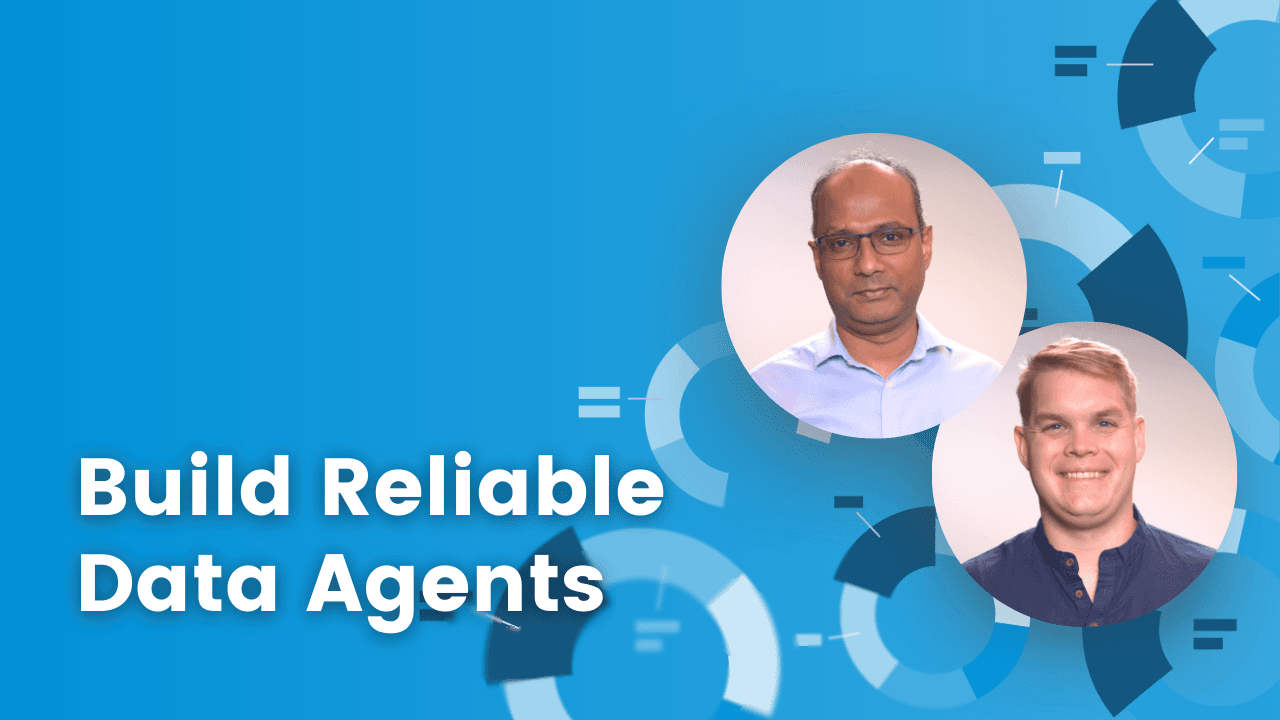
Instructors: Anupam Datta, Josh Reini

Earn an accomplishment with PRO · Updated Nov 18, 2025
- Intermediate
- 8 Video Lessons
- 5 Code Examples
- 1 Graded Assignment PRO
- Earn an accomplishment with PRO
- Updated Nov 18, 2025
- Instructors: Anupam Datta, Josh Reini
 Snowflake
- Learn more aboutMembership PRO Plan
What you'll learn
Trace and evaluate: measure the quality of the agent’s final answer, and the alignment of the agent’s goal, plan, and action.
Improve the agent’s performance: update the agent’s prompt, and add inline evaluations that the agent can use during runtime to adjust its plan.
Course recap
PROThis course, built in partnership with Snowflake, teaches how to implement and evaluate a multi-agent data system using LangGraph and TruLens. The data agent performs web searches, retrieves structured and unstructured enterprise data from Snowflake, generates visualizations, and synthesizes insights. Crucially, the course introduces GPA (Goal, Plan, Action) alignment as a framework for systematically evaluating agent quality.
Concept map
Key concepts
- AI AgentsData agents as autonomous systems connecting to data sources, understanding natural language queries, and providing insights
- GPA (Goal, Plan, Action) alignmentFramework for evaluating agent trustworthiness through plan quality, plan adherence, execution efficiency, and logical consistency
- Retrieval-Augmented GenerationRAG triad of context relevance, groundedness, and answer relevance for evaluating retrieval quality
- Multi-agent orchestrationHierarchical planner-executor architecture with specialized sub-agents
- Inline evaluationReal-time scoring during agent execution that enables dynamic replanning
Lesson highlights
- 1.Introduction — What data agents are and the GPA evaluation framework
- 2.What is a Data Agent? — Definition, architecture, and trustworthiness criteria
- 3.Construct a Multi-Agent Workflow — Building planner, executor, and sub-agents with LangGraph
- 4.Expand Data Agent Capabilities — Adding Snowflake Cortex for text-to-SQL and document search
- 5.Observe Agent Performance — Tracing with OpenTelemetry and RAG triad evaluation
- 6.Measure Agent's GPA — Plan quality, adherence, execution efficiency, and logical consistency
- 7.Improve Agent's GPA — Inline evaluations, prompt updates, and before/after comparison
- 8.Conclusion — Course recap
About this course
Learn how to build and evaluate a data agent in “Building and Evaluating Data Agents,” a course created in collaboration with Snowflake, and taught by Anupam Datta, AI Research Lead, and Josha Reini, Developer Advocate at Snowflake.
You’ll design a data agent that connects to data sources (databases, files) and performs web searches to respond to users’ queries. The agent will consist of sub-agents, each specialized in connecting to a particular data source, and other sub-agents that summarize or visualize the results. To answer a particular query, the agent will use a planner that identifies which sub-agents to call and in what order.
You’ll add observability to the agent’s workflow and evaluate the quality of its output. Using an LLM-as-a-judge approach, you’ll assess whether the final answer is relevant to the user’s query and grounded in the collected data. You’ll also evaluate the process by determining whether the agent’s goal, plan, and actions (GPA) are all aligned.
Finally, you’ll apply inline evaluations to evaluate the agent’s performance during runtime. At every retrieval step, you’ll evaluate if the collected data is relevant to the user’s query. The agent will use this evaluation score to decide if it needs to adjust its plan.
What you’ll do, in detail:
- Understand what data agents are and how they can be trustworthy when their goal, plan, and actions are properly aligned.
- Build a data agent that plans, performs web searches ,and visualizes or summarizes the results, using a multi-agent workflow implemented in LangGraph.
- Expand the agent’s capabilities by adding a Cortex sub-agent that retrieves information from structured and unstructured data stored in Snowflake.
- Add tracing to the agent’s workflow to log the steps it takes to answer a query.
- Evaluate the context relevance of the retrieved results, the groundedness of the final answer, and its relevance to the user’s query.
- Measure the alignment of the agent’s goal, plan, and actions (GPA) by computing metrics such as plan quality, plan adherence, logical consistenc,y and execution efficiency.
- Improve the agent’s performance by adding inline evaluations and updating the agent’s prompt..
By the end, you’ll know how to build, trace, and evaluate a multi-agent workflow that plans tasks, pulls context from structured and unstructured data, performs web search, and summarizes or visualizes the final results.
Who should join?
This course is ideal for AI builders who want to build and evaluate intelligent agents that can autonomously extract, analyze, and provide insights from various data sources. Basic knowledge of Python and object-oriented programming is recommended.
Course Outline
8 Lessons・5 Code Examples- Building and Evaluating Data AgentsVideo・4m
- What is a Data Agent?Video・13m
- Construct a Multi-Agent WorkflowVideo with Code Example・23m
- Expand Data Agent CapabilitiesVideo with Code Example・12m
- Observe Agent PerformanceVideo with Code Example・16m
- Measure Agent’s GPAVideo with Code Example・29m
- Improve Agent's GPAVideo with Code Example・9m
- ConclusionVideo・1m
- Quiz
Graded・Quiz
・10m
Elevate your learning experience with Pro
Upgrade to Pro and gain unlimited accomplishments on your resume
Instructors



Course access is free for a limited time during the DeepLearning.AI learning platform beta!
Want to learn more about Generative AI?
Keep learning with updates on curated AI news, courses, and events, as well as Andrew’s thoughts from DeepLearning.AI!